[ Full-stack AI infrastructure ]
Design. Build. Operate. GPU Clusters.
Applications
Training · Inference · Agents
Frameworks & runtime
PyTorch · vLLM · NCCL / RCCL
Orchestration
Slurm · Kubernetes
Fabric & storage
NVLink · UALink · IB · RoCE
Accelerators & nodes
GB300 · MI355X · custom ASICs
Power & cooling (MEP)
UPS · PDU · CDU · Chillers
[ End to end ]
From business caseto running cluster.
The same operators who will run the cluster plan, size, build, and prove it. Open any stage.
A cluster is a revenue asset, not a capex line. Before power is contracted or a GPU is ordered, we check that the business case closes and the site can deliver it.
- Capex and opex by phase and year, from accelerators to people
- Utilization-to-revenue curve: break-even at 40%, 60%, and 80% booked
- Sensitivity on power tariff, hardware lead time, and depreciation
- Financing readiness: vendor financing, GPU-backed structures, AI-compute programs
You getAn investment memo with a go / no-go, a phased capex plan, and a site scorecard.
Planning and feasibilityWe map the site, power, and cooling envelope before a single rack ships, so the build fits the environment instead of fighting it.
- Power and cooling envelope: kW per rack, CDU and chiller sizing, PUE target
- Hall layout: rack count, containment, and expansion path
- Structured cabling and an MEP integration plan
- Edge, colocation, modular, and greenfield variants
You getA site design the racks will actually fit, with headroom for the next phase.
Datacenter scopingThe right accelerators for the workload, not the biggest line item. We size against your inference, training, and agentic profiles, so you buy capacity you will use.
- Workload profiling: model sizes, context lengths, batch shapes
- Accelerator choice across NVIDIA, AMD, and custom silicon
- Node count, storage, and memory tiering sized to the profile
- What you buy now vs. what you add in 12 months
You getA bill of materials tied to a revenue model, not to a vendor quota.
GPU sizingRacks, nodes, and topology assembled to a plan that survives contact with production. Power distribution, cabling, and layout done once, done right.
- Rack elevation, PDU and busway design, liquid-cooling manifolds
- Node configuration: BIOS, firmware baseline, OS image, drivers
- Cable plant labelled and documented, every port traceable
- Scheduler bring-up: Slurm, PBS, or Kubernetes with health checks
You getA cluster built to a documented baseline the platform verifies against for its whole life.
Cluster buildingReal-workload baselines, not synthetic hero numbers. You see tokens per second, utilization, and failure behavior under load before the cluster goes live.
- Your models and batch shapes: tokens/s, TTFT, MFU, and $/token
- NCCL or RCCL collectives at every gang size; HPL and storage as the floor
- Failure injection: pulled cables, throttled GPUs, drained nodes
- Baselines stored as the production reference
You getA performance contract you can hold vendors, and us, to.
BenchmarkingBurn-in, validation, and handoff. We stress every node, confirm the numbers match the plan, and hand over a cluster the platform is already watching.
- Multi-day burn-in per node: thermal, ECC, PCIe, link-margin drift
- Readiness checks, with an evidence pack for your buyers
- Runbooks, as-built documentation, and operator training
- Agents enrolled and playbooks active on handoff day
You getA cluster that enters the revenue pool already under watch.
CommissioningHandoff is when the Factryze platform takes over: fleet health, utilization, idle cost, and rack-level GPU state, in the same view our commissioning team used.
- Detect, diagnose, remediate, verify: drain, quarantine, or reset through the scheduler
- Predictive drain before an SLA breach, with a cross-layer timeline per incident
- Drift in tokens/s, link margin, or thermals flagged before it costs revenue
- Run it with your team on our platform, or have us run it, SLA-backed
You getNo discovery phase: the platform starts with the as-built model, baselines, and playbooks.
The platform
[ The Factryze platform ]
Reliability as a servicefor GPU clusters.
The SLA-backed operations reliability platform behind every cluster we build. Already in production? Start here.
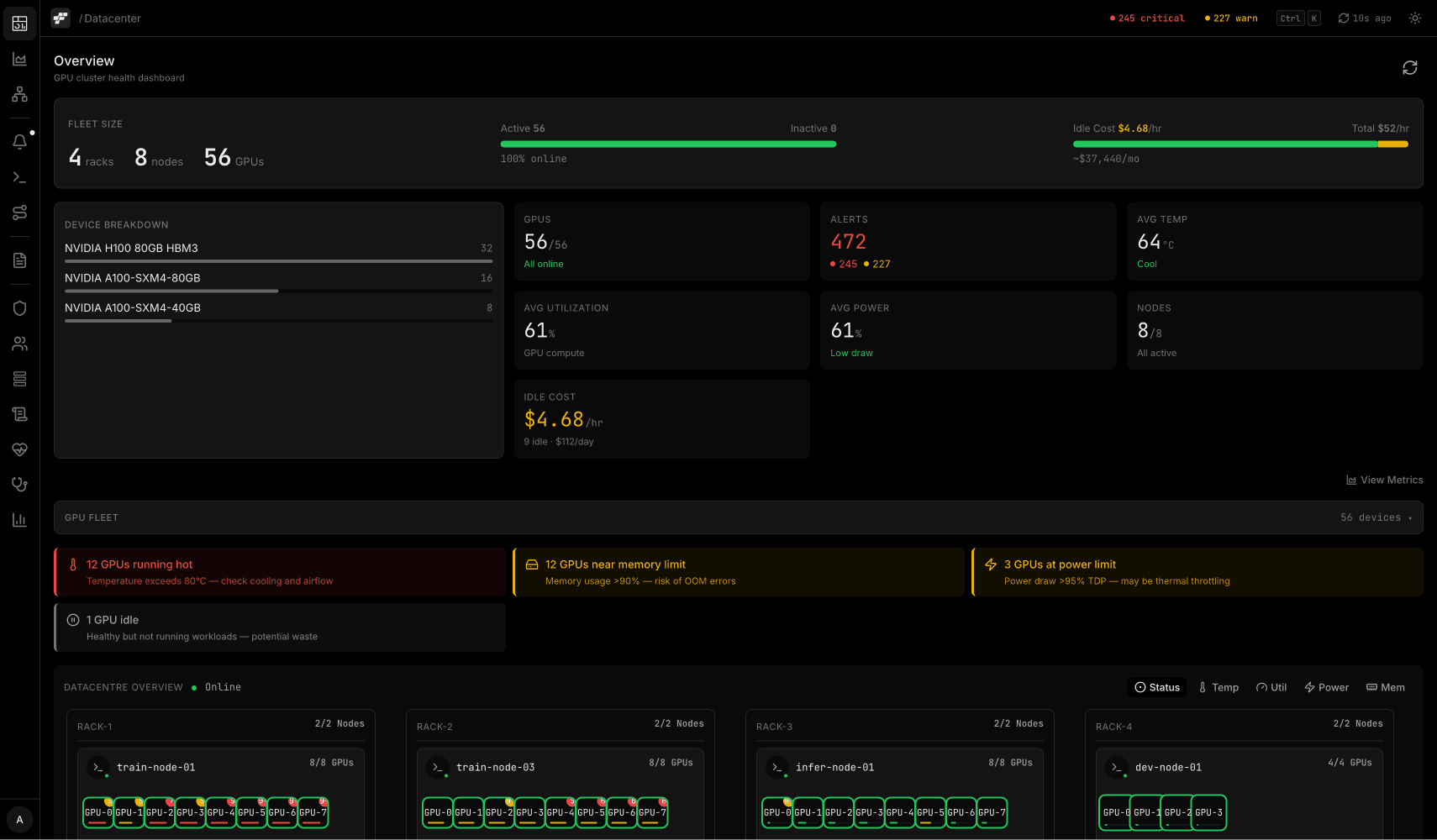
01 · Failures contained early
Faults caught and fixed before they cost a job.
02 · Measured against the design
Production checked against acceptance baselines.
03 · Engineers on the other end
Reliability engineers who know your cluster, on call.
- Read-only telemetry
- Outbound HTTPS only
- No inbound ports or SSH
- Non-root collector
[ How we work ]
One team, feasibility to fleet.Start at any phase.
The same engagement lead from the first site visit to 24x7 operations.
01 · Feasibility
Should you build, where, and how big?
Details on feasibility02 · Design
A plan your vendors can build from.
Details on design03 · Deploy
Built to the design, proven under load.
Details on deploy04 · Operate
SLA-backed operations, 24x7.
Details on operate
[ The problem ]
Running GPU clustersis brutally hard.
These failure modes quietly waste expensive compute.
01 · Token economics
Cost per token drifts, and nobody knows why.
02 · Silent failures
ECC errors and throttling burn hours before anyone notices.
03 · Slow response
Engineers SSH into nodes while GPUs sit idle.
04 · Lost utilization
Scheduling and thermal limits leave performance on the table.
[ Reliability and security ]
Proven under loadbefore it carries revenue.
We build and run every cluster against the published criteria GPU clouds are rated on, including SemiAnalysis's ClusterMAX.
01 · Audit~15 min
Config checks. Free with the open-source CLI.
02 · PerformanceHours
Benchmarked at acceptance, against the design.
03 · ReliabilityDays
Burn-in and failure injection before go-live.
Reliability in production
Bad nodes drained before the next job lands.
Security
Read-only, outbound-only, scoped per tenant.
ClusterMAX is a trademark of SemiAnalysis. Factryze is not affiliated with or endorsed by SemiAnalysis, and a Factryze audit is not a ClusterMAX rating. What our audit covers.
Integrates with your existing infrastructure
 Kubernetes
 NVIDIA
 Docker
 Prometheus
 Grafana
 Linux
 Terraform
Frequently asked questions
Tell us where you are in the build.
Evaluating a site, holding a design, waiting on hardware, or already in production: start with a 30-minute scoping call.